

One of the great things about getting older is that, if you choose to, you can start to relax a bit. In the first and second acts, it seems to me a person spends so much time trying to figure things out, trying to decide whether to go “this way or that way”, spending all kinds of energy being anxious about a whole lot of things. I know I did. Over the past years something good (at least I think it is good) has been happening to me. I have stopped wondering why certain things are happening and instead I have allowed myself to accept the unusual and interesting ways that life “self-organizes”. The concept of “self-organization” is central to the description of biological systems. I certainly don’t pretend to understand much of this. I simply love the idea that life in general, which includes of course, my specific life, “self-organizes”.
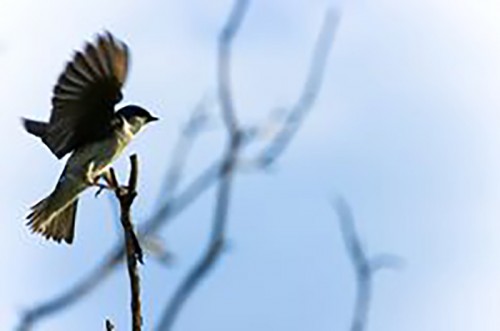
This idea reminds me of something that I read many years ago in Annie Dillard’s book, “Pilgrim at Tinker Creek”. By any stretch of the imagination, Annie is an interesting person whose prose requires a certain kind of engagement from the reader. In “Pilgrim” (a book for which Annie won a Pulitzer Prize) she basically tells the story of how she devoted a year of her life to simply wandering in the outdoors behind her home, stopping and watching life unfold, for as long as it took. If that meant sitting for several hours watching a caterpillar make its way along a log then so be it. The exercise was about paying attention and staying curious. The particular example that I am referring to here was this. One day, as Annie was walking along a path in the woods, she saw a bird perched on a branch, high atop one of the trees. The bird was facing away from her. She stopped and watched this bird for some time. Then, without any warning, the bird stepped off the branch and began to plummet toward the earth below. Just before it would have collided with terra firma, it spread its wings and majestically soared back into the sky.
Annie Dillard asked herself, “Why did it do that? Presumably it did not know that I was here and even if it did it had no reason to do what it just did.” This of course raised in her mind that philosophical conundrum, “if a tree falls in the forest and there is no one there to hear it, does it make a sound”. She wondered about that in relation to this bird’s display. And then she wrote this: “The answer must be, I think, that beauty and grace are performed whether we will or sense them. The least we can do is try to be there” (italics mine). That last phrase has stayed with me ever since I first read it and while I have to confess that I have not always lived by that truth, these days, I am seeing its poignancy more and more. Today I would say it this way, “Life is going to self-organize in whatever way it wants, and the least I can do is try to be there.”
A case in point happened to me recently. I was sitting in my usual café, working on “whatever” and I noticed a young man sitting across the café, reading. As he got up to leave he said hello and I heard an accent “not from here”. Turns out he was from Australia and since I was going to be heading to Australia in a few weeks, we had an immediate point of reference. That simple “hello” has turned into what for me is becoming a new friendship with someone whom I would call a “reverse mentor” – someone much younger who can mentor me. I have no idea where this new friendship will go and in some ways, it doesn’t really matter. All I know is that if I can stay curious, keep my eyes and hands open for whatever might come along on any given day, then I might just get the opportunity to experience something that I couldn’t back in my “uptight days”. I just have to keep remembering, that “the least I can do is try to be there”.
Stay curious and see how life will “self-organize”. Not a bad mantra to live by.
 The Third Act